
Free CPR calculator for Indian traders.
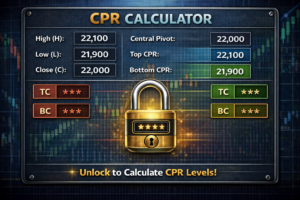
CPR Calculator (Central Pivot Range)
Get Pro Setup Now (Free)
 Chat on WhatsApp
CPR Calculator in India
The CPR Calculator helps traders determine the Central Pivot Range using previous day price data. Unlike many traditional indicators, this method focuses on overall market structure rather than only price direction. Because of this, it becomes highly effective for understanding intraday market behavior. As a result, professional traders frequently rely on CPR levels to prepare trade plans before the market opens.
Within the Indian stock market, especially in NSE intraday trading, CPR levels offer valuable insights into daily price movement. Since price often reacts within or around CPR zones, traders can anticipate whether the session may trend or remain range-bound. In addition, these levels help reduce emotional decision-making and improve planning discipline.
How Does the CPR Calculator Work?
To calculate CPR, the tool requires three inputs: previous day high, previous day low, and previous day close. After these values are entered, the calculator processes them to generate three important levels. These levels include the Pivot (P), Top Central (TC), and Bottom Central (BC). Together, they form the Central Pivot Range, which defines the core trading zone for the day.
CPR Formula Used
Initially, the pivot value is calculated using the average of the high, low, and close prices. Next, BC is derived from the average of high and low values. Finally, TC is calculated by combining the pivot and BC relationship.
Pivot (P) = (High + Low + Close) ÷ 3
Bottom Central (BC) = (High + Low) ÷ 2
Top Central (TC) = (Pivot − BC) + Pivot
Example
Consider the following data:
High = ₹22,550
Low = ₹22,300
Close = ₹22,420
Using these inputs, the pivot becomes ₹22,423. Meanwhile, BC is calculated at ₹22,425, and TC forms near ₹22,421. Together, these values create the CPR trading zone for the session.
Why CPR Is Important
The width of CPR provides traders with important information about market conditions. When CPR is narrow, volatility potential increases significantly. On the other hand, a wide CPR often indicates range-bound behavior. Therefore, traders choose their strategies based on CPR width.
Using CPR in Intraday Trading
If price opens above the CPR zone, bullish bias tends to strengthen. Conversely, opening below CPR suggests bearish pressure may dominate. At the same time, price trading inside CPR signals sideways conditions. Consequently, traders adjust position size, risk exposure, and expectations accordingly.
Who Should Use This Calculator?
Intraday traders benefit from CPR because it helps them plan breakouts and reversals. Scalpers also use these levels for quick decision-making. Furthermore, futures traders rely on CPR for trend bias. Even NSE equity traders can apply CPR to understand daily market structure more clearly.
Best Practices
To improve accuracy, combine CPR with volume analysis and trend confirmation. Additionally, traders should always follow strict risk management rules. Most importantly, avoid overtrading during low-volatility sessions, as false signals can increase.
FAQs
What is CPR in trading?
CPR stands for Central Pivot Range and helps identify key intraday zones.
What does narrow CPR mean?
It indicates potential trending conditions due to compressed price zones.
Is CPR useful for NSE traders?
Yes, it works effectively for Indian intraday markets.
Related Calculators
Disclaimer
This calculator is for educational purposes only and does not provide trading or investment advice.