
Free Expected Move calculator for Indian traders.
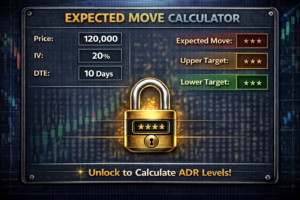
Expected Move Calculator
Get Pro Setup Now (Free)
 Chat on WhatsApp
Expected Move Calculator in India
The Expected Move Calculator helps traders estimate how much a stock or index is likely to move over a specific period based on volatility. Many traders enter trades without understanding how far price is statistically expected to travel. This often results in unrealistic targets, premature exits, or holding positions beyond logical limits. Understanding the expected move improves probability-based decision making.
In the Indian stock market, especially for options and intraday traders, expected move plays a major role. Since volatility drives price expansion, this calculator simplifies movement forecasting using volatility inputs and time.
What Is Expected Move?
Expected move represents the projected price range within which an asset is statistically likely to trade during a given period.
It can be used for:
Intraday expectations
Weekly options planning
Event volatility estimation
Professional traders use expected move to define boundaries, not exact price predictions.
Why Expected Move Matters for Indian Traders
Expected move helps traders avoid emotional expectations. When the probable range is known:
Targets become realistic
Options sellers define risk zones
Breakout expectations become logical
Risk management improves
Trading without expected move knowledge leads to chasing price beyond normal volatility.
How the Expected Move Calculator Works
This calculator typically uses:
Current price
Implied volatility (IV)
Time period (days)
The logic is based on the volatility formula:
Expected Move = Price × IV × √(Days / 365)
This provides the likely movement range.
Expected Move Trading vs Guess Trading
Expected-move-based trading aligns with statistical probability. Guess trading relies on emotional predictions.
Expected move trading offers:
Probability-based targets
Better options strategy planning
Controlled risk exposure
Guess trading leads to overconfidence and poor consistency.
Why This Calculator Is Useful for Options Trading
Options traders benefit because:
Helps price straddle and strangle ranges
Identifies safe selling zones
Defines volatility expansion expectations
Avoids overpaying for premium
Expected move is widely used by professional options desks.
Using Expected Move for Intraday Trading
Intraday traders use expected move to:
Avoid chasing late breakouts
Set realistic targets
Understand volatility expansion
Control trade size
It acts as a statistical boundary tool.
Using Expected Move with Other Indicators
For better accuracy, combine expected move with:
ADR
VWAP
Support and resistance
Volume
Volatility defines range, structure defines direction.
Common Mistakes Traders Make
Many traders:
Expect moves beyond statistical limits
Ignore volatility changes
Hold options after expected move completion
Trade emotionally during events
The calculator helps prevent these errors.
Who Should Use This Expected Move Calculator?
This tool is ideal for:
Options traders
Intraday traders
Volatility traders
Index traders
Event-based traders
Benefits of Knowing Expected Move
Realistic profit targets
Improved options selling
Reduced emotional trading
Better risk control
Higher consistency
Understanding volatility improves professional decision making.
Best Practices
Use updated IV data
Avoid trades after full expected move
Combine with risk management
Do not rely on it alone
Related Calculators
For official market data, refer to the National Stock Exchange of India.
Expected Move Calculator
This tool helps traders estimate probable price movement using volatility, improving target setting and trade discipline.
Disclaimer: This Expected Move Calculator is for educational purposes only and does not provide trading or investment advice.