
Free Portfolio Risk calculator for Indian traders.
Portfolio Risk Calculator
Free NSE Trend Finder
Portfolio Risk Calculator in India
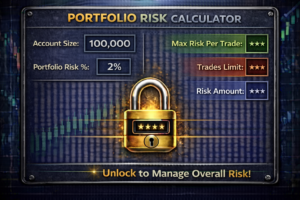
The Portfolio Risk Calculator helps traders measure total capital exposure across multiple open trades. Many traders calculate risk per trade correctly; however, they often ignore cumulative portfolio exposure. As a result, overall risk can quietly become dangerously high. When several trades are open simultaneously, total capital at risk may exceed safe limits. Therefore, understanding portfolio-level risk is essential for long-term survival.
In the Indian stock market, especially in intraday and futures trading, holding multiple positions is common. Moreover, these positions are often correlated. Consequently, even well-planned individual trades can create significant drawdowns when market conditions shift suddenly. This calculator simplifies portfolio exposure calculation using capital size, risk percentage, and number of open trades.
What is Portfolio Risk?
Portfolio risk refers to the total potential loss if all open trades hit their stop losses at the same time. In other words, it measures combined exposure rather than isolated trade risk.
For example:
Capital = ₹5,00,000
Risk per trade = 2%
Open trades = 3
Risk per trade = ₹10,000
Total portfolio risk = ₹30,000
Thus, 6% of total capital is exposed.
Professional traders focus not only on single trades but also on total exposure. Because of this, they avoid over-leveraging their capital.
Why Portfolio Risk Matters for Indian Traders
Indian markets can become highly volatile during:
RBI announcements
Budget sessions
Global news events
Geopolitical tensions
During such events, multiple trades may move against a trader simultaneously. Consequently, losses can compound quickly.
Without portfolio control:
Drawdowns increase rapidly.
Capital recovery becomes harder.
Emotional pressure intensifies.
On the other hand, when exposure is controlled:
Capital preservation improves.
Stress levels reduce.
Consistency increases over time.
That is why portfolio risk management is critical.
How the Portfolio Risk Calculator Works
This calculator uses three inputs:
Total trading capital
Risk percentage per trade
Number of open trades
First, it calculates risk per trade:
Risk per trade = Capital × Risk %
Next, it multiplies that amount by the number of open positions:
Total exposure = Risk per trade × Number of trades
Finally, it converts exposure into a portfolio percentage. As a result, traders can clearly see total capital at risk.
Individual Trade Risk vs Portfolio Risk
Individual trade risk focuses on a single position. However, portfolio risk measures cumulative exposure.
For instance, risking 2% on one trade is reasonable. Nevertheless, risking 2% on five trades simultaneously means 10% total exposure. Consequently, a single market event can significantly impact capital.
Therefore, both levels of risk management must work together.
Why This Calculator Is Useful for Intraday Trading
Intraday traders frequently:
Open multiple index trades
Trade several stocks at once
Scale into positions
Because of this, risk multiplies quickly.
Without portfolio-level awareness:
Exposure increases unintentionally.
Stop losses may trigger together.
Capital volatility rises.
In contrast, structured portfolio monitoring allows better control.
Using Portfolio Risk for Futures Traders
Futures traders benefit significantly from portfolio risk tracking. Since futures involve leverage, exposure grows faster than expected.
For example, holding Nifty futures and Bank Nifty futures at the same time increases correlation risk. Moreover, adding stock futures in the same direction amplifies exposure.
Therefore, calculating total risk before adding new trades prevents overexposure. In addition, it protects capital during volatile sessions.
Portfolio Risk and Correlation
Even if trades appear diversified, they may still be correlated.
For instance:
Long Nifty
Long Bank Nifty
Long Reliance
Although these are different instruments, they may move together during market-wide corrections. Consequently, effective portfolio risk may be higher than calculated.
Because of this, experienced traders adjust exposure during high correlation periods.
Common Mistakes Traders Make
Many traders focus heavily on entries. However, they ignore cumulative risk. As a result:
They overtrade in trending markets.
They increase position size after winning streaks.
They underestimate correlated exposure.
Over time, such habits create unnecessary drawdowns.
Who Should Use This Portfolio Risk Calculator?
This tool is ideal for:
Intraday traders
Futures traders
Swing traders
Options traders
Active portfolio managers
In fact, anyone managing more than one open trade should monitor total exposure regularly.
Benefits of Measuring Portfolio Risk
When portfolio risk is tracked consistently:
Capital preservation improves.
Emotional decision-making decreases.
Drawdowns remain controlled.
Long-term sustainability increases.
Ultimately, survival in markets depends more on risk control than prediction accuracy.
Best Practices for Portfolio Risk Management
To maintain discipline:
Limit total portfolio exposure to 5–8% at any time.
Reduce risk during high-volatility sessions.
Avoid stacking highly correlated trades.
Lower risk during drawdown periods.
Never exceed predefined exposure rules.
Overall, capital safety should always take priority over aggressive growth.
Related Calculators
Multi Target Projection Calculator
Portfolio Risk Calculator
The Portfolio Risk Calculator helps traders measure cumulative capital exposure across multiple trades. As a result, it improves discipline, reduces unnecessary drawdowns, and supports long-term trading sustainability.
Disclaimer: This Portfolio Risk Calculator is for educational purposes only and does not provide trading or investment advice.