
Free intraday slippage cost calculator for Indian traders
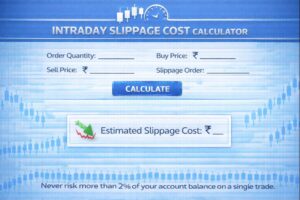
Intraday Slippage Cost Calculator
Free NSE Trend Finder
Intraday Slippage Cost Calculator in India
The intraday slippage cost calculator helps traders calculate the hidden cost caused by price slippage during intraday trading. Many beginner traders focus only on profit, loss, and brokerage, but they ignore slippage. Over time, slippage can silently reduce profitability, even if the trading strategy looks good on paper.
This calculator is specially designed for Indian intraday traders who trade NSE stocks and indices. It clearly shows how small differences between expected price and executed price can create meaningful losses.
What Is Slippage Cost in Intraday Trading?
Slippage cost in intraday trading refers to the difference between the price at which a trader plans to enter or exit a trade and the actual price at which the order gets executed.
Slippage usually happens because of:
-
High market volatility
-
Low liquidity in stocks
-
Use of market orders
-
Fast price movement during breakouts
For example, if a trader expects to buy a stock at ₹250 but gets executed at ₹252, the ₹2 difference is slippage.
Why Intraday Slippage Cost Calculator Is Important for Beginners
The intraday slippage cost calculator is extremely important for beginners because slippage is often invisible in basic P&L calculations. Many traders blame their strategy or indicator when they lose money, while the real reason is poor execution.
Understanding slippage helps traders:
-
Trade liquid stocks
-
Avoid volatile time zones
-
Use limit orders wisely
-
Improve real profitability
Without measuring slippage cost, traders cannot accurately evaluate their intraday performance.
How Does the Intraday Slippage Cost Calculator Work?
The intraday slippage cost calculator works using a simple price difference method. It compares what you expected versus what actually happened in the market.
Inputs Used in Intraday Slippage Cost Calculation
The calculator uses three basic inputs:
-
Expected entry or exit price
-
Executed price
-
Quantity traded
These inputs are enough to calculate the total slippage cost for a trade.
Slippage Cost Formula Used in Calculator
Slippage per Share = Executed Price − Expected Price
Total Slippage Cost = Slippage per Share × Quantity
This formula shows how slippage increases as position size increases.
Intraday Slippage Cost Calculation Example
Let us understand the intraday slippage cost calculation with an example:
-
Expected Price = ₹250
-
Executed Price = ₹252
-
Quantity = 200 shares
Slippage per share = ₹2
Total slippage cost = ₹2 × 200 = ₹400
This ₹400 loss happens even before brokerage, stop loss, or target is considered.
Who Should Use an Intraday Slippage Cost Calculator?
This calculator is useful for:
-
Beginner intraday traders
-
Scalpers and momentum traders
-
Traders facing unexplained losses
-
Traders using market orders frequently
Anyone trading intraday should calculate slippage to understand real execution costs.
Common Slippage Mistakes in Intraday Trading
Many intraday traders lose money because of avoidable slippage mistakes such as:
-
Trading illiquid stocks
-
Entering during news or opening volatility
-
Using market orders blindly
-
Trading large quantity in thin stocks
Tracking slippage cost helps traders correct these mistakes early.
Intraday Slippage Cost vs Brokerage Charges
Most traders focus only on brokerage charges, but intraday slippage cost can be much higher than brokerage.
-
Brokerage is fixed and predictable
-
Slippage is variable and hidden
Reducing slippage often improves profitability more than switching brokers.
Related Intraday Trading Calculators
To improve intraday trading performance, traders can also use:
These tools work best when combined with slippage awareness.
For official market data and trading rules, traders can refer to the National Stock Exchange of India.
Disclaimer
This calculator is for educational purposes only and does not provide trading or investment advice.