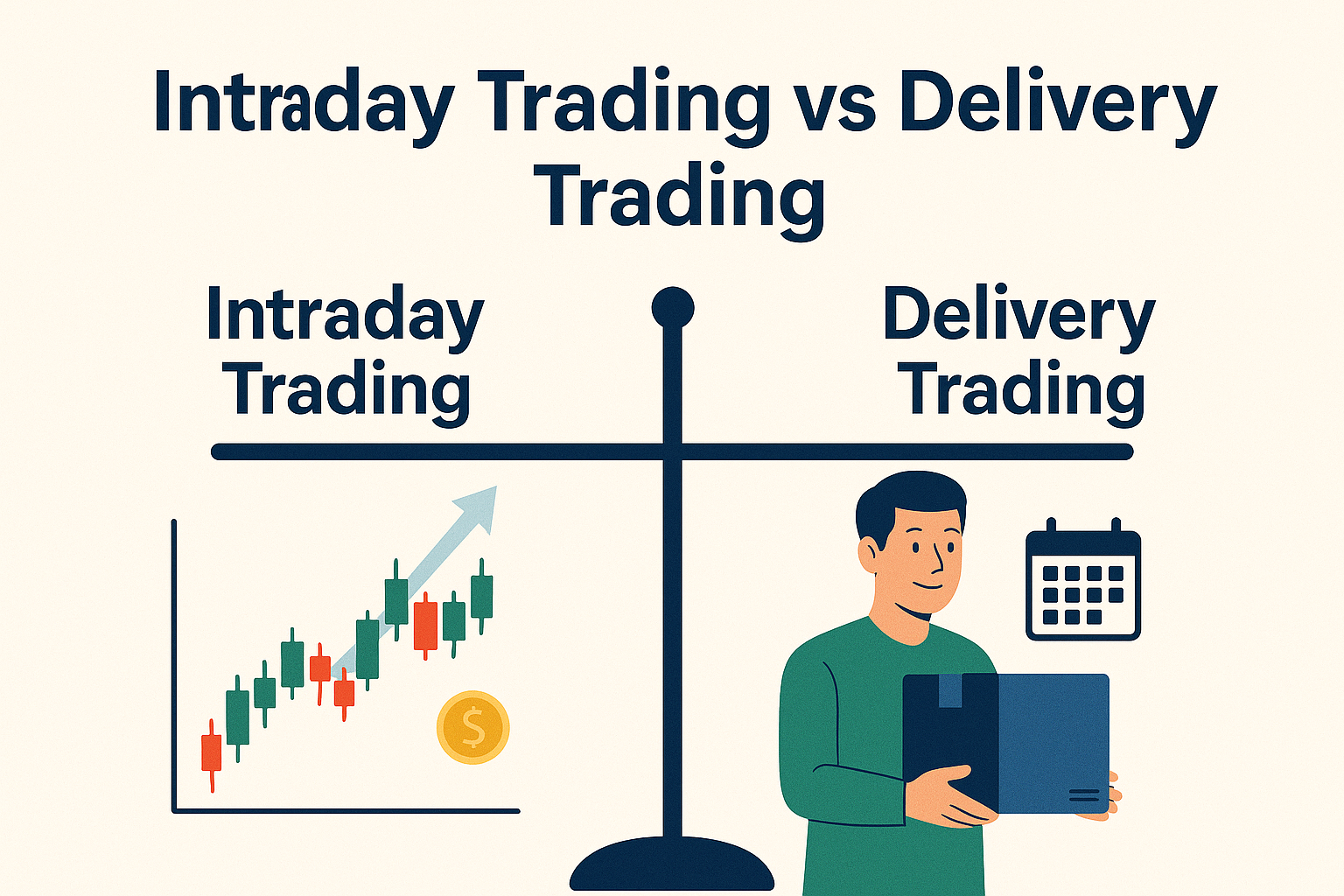
Intraday Trading vs Delivery Trading: Key Differences Explained
Introduction
Every beginner entering the stock market faces one common question —
Should I trade intraday or invest in delivery?
While both involve buying and selling shares, the purpose, duration, and risk behind them are completely different.
In this blog, you’ll clearly understand the difference between intraday and delivery trading, which is better for you and how to choose the right style based on your goals and risk appetite.
Get Pro Setup Now
1. What is Intraday Trading?
Intraday trading means buying and selling a stock within the same day.
All positions are squared off before the market closes (3:15 PM).
Key features:
-
Duration: Same-day trades only.
-
Goal: Quick profits from price movement.
-
Risk: High (due to leverage and volatility).
-
Example: Buying Infosys at ₹1,500 and selling it at ₹1,520 on the same day = ₹20 profit per share.
Who should do it?
Traders who can monitor markets regularly, follow rules, and manage emotions well.
2. What is Delivery Trading?
Delivery trading means buying shares and holding them in your Demat account for days, weeks, or even years.
Key features:
-
Duration: Long-term holding (no same-day exit required).
-
Goal: Gradual wealth creation.
-
Risk: Lower than intraday due to time advantage.
-
Example: Buying Infosys at ₹1,500 and holding till ₹1,700 after a few weeks or months.
Who should do it?
Investors who prefer steady growth, dividends, and minimal daily monitoring.
3. Core Differences Between Intraday and Delivery Trading
| Factor | Intraday Trading | Delivery Trading |
|---|---|---|
| Time Frame | Same day | Days, months, years |
| Objective | Quick short-term profits | Long-term investment |
| Ownership | No delivery of shares | Shares credited to Demat |
| Margin Requirement | Low margin, high leverage | Full payment required |
| Risk Level | High (short-term volatility) | Moderate to low |
| Suitable For | Active traders | Passive investors |
| Brokerage & Charges | Lower per trade but frequent | Slightly higher but fewer trades |
| Market Focus | Technical analysis & charts | Fundamental analysis & news |
This table makes it clear: intraday = active trading, while delivery = patient investing.
4. Which One is More Profitable?
Profit depends on your skill and consistency, not the method.
-
Intraday: Offers daily earning potential but needs time, analysis, and emotional control.
-
Delivery: Offers long-term compounding and stability, but slower returns.
Pro tip:
Many successful traders use a hybrid approach —
do intraday for daily cash flow and delivery for wealth creation.
5. Taxation Difference
| Type | Considered As | Tax Type | Holding Period | Tax Rate |
|---|---|---|---|---|
| Intraday Trading | Speculative Income | Normal Income Tax Slab | Same Day | As per your income slab |
| Delivery Trading (Short Term) | Capital Gain | STCG (Short Term Capital Gains) | < 1 Year | 15% |
| Delivery Trading (Long Term) | Capital Gain | LTCG (Long Term Capital Gains) | > 1 Year | 10% (above ₹1 lakh) |
So, intraday traders pay tax as per income, while delivery traders pay capital gains tax.
6. Which One is Better for Beginners?
| If You Have… | Choose… |
|---|---|
| Time to monitor markets daily | Intraday Trading |
| Limited time / full-time job | Delivery Trading |
| Higher risk tolerance | Intraday |
| Moderate risk appetite | Delivery |
| Goal: Regular income | Intraday |
| Goal: Long-term wealth | Delivery |
Bottom line: Start small with delivery trading to understand markets, then slowly explore intraday once disciplined.
7. Risk & Reward Comparison
-
Intraday Pros: Quick profits, daily opportunities, no overnight risk.
-
Intraday Cons: High volatility, emotional stress, requires precision.
-
Delivery Pros: Safer, long-term returns, dividends, lower stress.
-
Delivery Cons: Slow returns, overnight risk from global events.
Quick Checklist 🧾
✅ Intraday = same-day trade → focus on timing.
✅ Delivery = long-term → focus on fundamentals.
✅ Never mix the two mindsets in one account.
✅ Use intraday for skill, delivery for growth.
✅ Know your risk level before choosing.
FAQs
Q1. Can I do both intraday and delivery trading?
Yes. You can maintain both trading and investment portfolios separately.
Q2. Which gives better returns — intraday or delivery?
Intraday gives faster profits but higher risk; delivery gives stable long-term gains.
Q3. Is intraday trading risky for beginners?
Yes, due to leverage and volatility. Beginners should practice first before using real capital.
Q4. How much capital do I need for delivery trading?
You can start delivery trading with even ₹1,000–₹5,000 using fractional shares or ETFs.
Q5. Do I pay different taxes for intraday and delivery?
Yes. Intraday = speculative income; Delivery = capital gains (short/long term).
Closing Thoughts
Intraday and delivery trading are two sides of the same coin.
Intraday helps you learn price movement and speed; delivery builds your financial base slowly.
For beginners should begin with delivery trading to learn fundamentals, then move to intraday once disciplined and confident.
👉 Next Blog: Best Time Frame for Intraday Trading in India