
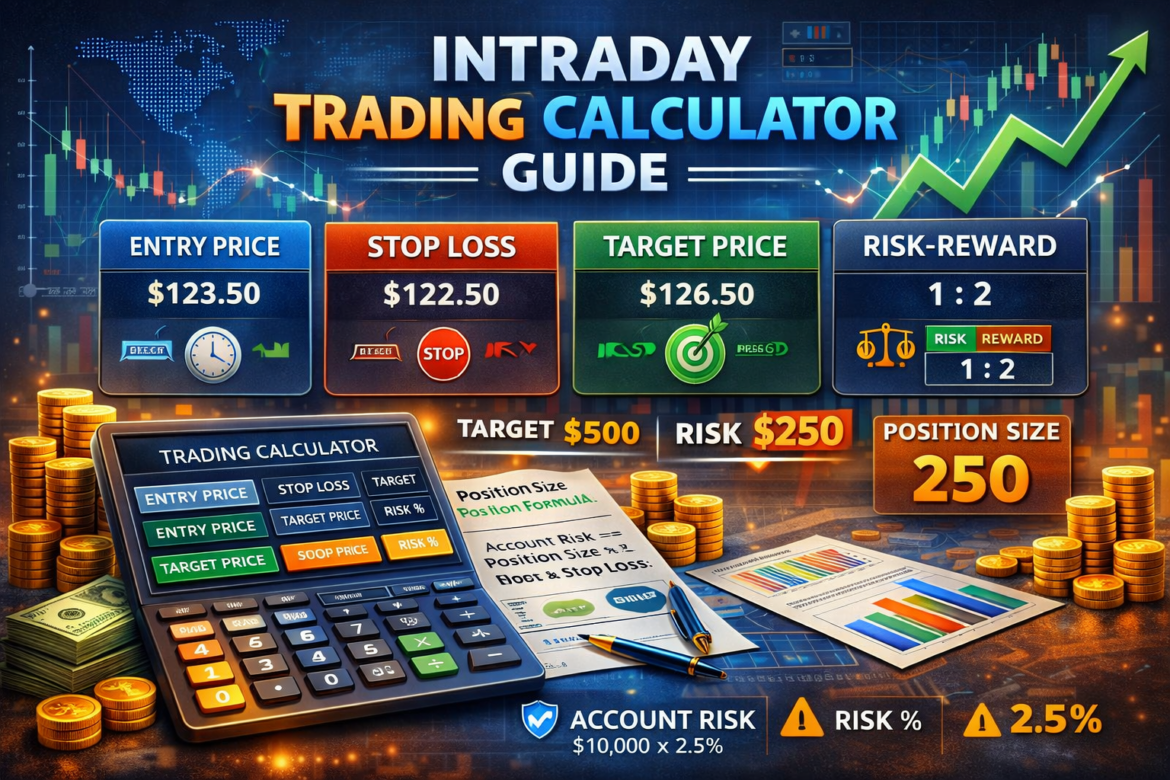
Intraday Trading Calculator
What is Intraday Trading Calculator
An intraday trading calculator is a powerful tool that helps traders make better and faster decisions during the trading day. In intraday trading, every second matters because price movements happen quickly. Therefore, manual calculations can lead to mistakes and missed opportunities.
Instead of calculating everything manually, traders use calculators to simplify complex decisions. These tools help in calculating position size, risk, profit targets, stop loss, and overall trade planning.
For example, a trader may want to know how many shares to buy based on a fixed risk. Without a calculator, this can take time and may result in incorrect calculations. However, with the help of an intraday trading calculator, the result is instant and accurate.
Moreover, these calculators improve discipline. Many traders lose money not because of a bad strategy, but because they do not follow proper risk management. By using Intraday Trading Calculator, traders can stick to predefined rules.
In addition, intraday trading calculator help reduce emotional decisions. Instead of guessing, traders rely on data and logic. As a result, consistency improves over time.
Another important benefit is speed. Since intraday trading requires quick decisions, having ready-to-use tools gives a competitive advantage.
Furthermore, these calculators are useful for both beginners and professional traders. Beginners can understand concepts easily, while experienced traders can optimize their strategies.
Therefore, using intraday trading calculator is not optional anymore. It is an essential part of modern trading.
Why Intraday Trading Calculator Are Important
Intraday trading involves multiple decisions such as entry, exit, risk, and capital allocation. Making these decisions without proper calculation increases the chances of loss.
First, calculators help in risk management. Traders can define how much capital they are willing to risk per trade.
Second, they improve accuracy. Even small calculation errors can lead to big losses.
In addition, Intraday Trading Calculator save time. Instead of spending minutes calculating, traders get instant results.
Moreover, they help maintain consistency. Following the same rules in every trade improves long-term performance.
Therefore, every trader should use Intraday Trading Calculator as part of their trading system.
Top 10 Intraday Trading Calculator
Below are the most important Intraday Trading Calculator that every intraday trader should use:
1.Risk Management Guide
2.Pivot Point Group
3.Intraday Position Sizing
4.Market Volatility Guide
5.Trend Analysis Guide
6.Trading Indicators Guide
7.Chart Pattern Trading Guide
8.Options Trading Guide
9.Trading Performance Guide
10.Advanced Trading Metrics
1. Risk Management Guide
Risk management is the most important part of intraday trading. It refers to the process of controlling potential losses and protecting your trading capital.
Many beginners focus only on finding the best stock or indicator. However, experienced traders know that even the best strategy can fail without proper risk management.
In trading, losses are unavoidable. Every trader, even professionals, face losing trades. The key difference between successful and unsuccessful traders is how they manage those losses.
For example, if a trader risks too much capital on a single trade, even a few losses can wipe out the entire account. On the other hand, if the trader controls risk and limits losses, they can survive and continue trading.
Therefore, the main goal of risk management is not just to make profit, but to protect capital.
One of the most common rules in trading is the 1% risk rule. This means a trader should risk only 1% of their total capital in a single trade.
For example:
If trading capital = ₹100000
Risk per trade = 1%
Maximum loss allowed = ₹1000
This approach ensures that even after multiple losing trades, the trader still has enough capital to continue.
In addition, risk management helps in emotional control. Large losses create stress and fear. As a result, traders may take impulsive decisions like revenge trading or overtrading.
However, when risk is controlled, traders remain calm and focused.
Moreover, proper risk management improves consistency. Instead of big ups and downs, trading results become more stable.
There are several important components of risk management:
Position Sizing – Deciding how much quantity to trade
Stop Loss – Limiting maximum loss in a trade
Risk-Reward Ratio – Ensuring profit potential is higher than loss
Daily Loss Limit – Stopping trading after a certain loss
All these factors work together to create a strong trading system.
Another important aspect is avoiding overtrading. Taking too many trades increases risk and reduces performance. Therefore, traders should focus on quality setups instead of quantity.
In fast-moving markets, manual calculations can be difficult. Therefore, traders use risk management calculators to simplify the process.
These tools help traders calculate position size, risk-reward ratio, and maximum loss instantly.
As a result, traders can make better decisions quickly.
In conclusion, risk management is the foundation of long-term trading success. Without it, even a profitable strategy can fail.
Every trader should focus on protecting capital first. Once capital is safe, profits will follow naturally.
Therefore, always use proper Risk Management Tool before entering any trade.
2.Pivot Point Group
Pivot Point Group is one of the most widely used tools in intraday trading. It helps traders identify important support and resistance levels where price is likely to react.
In simple terms, pivot points are calculated levels based on the previous day’s price data, including high, low, and close. These levels act as reference points for the current trading session.
Traders use pivot points to understand market direction and plan their trades accordingly.
The main pivot point (PP) is considered the central level. If the price is trading above the pivot point, the market is generally considered bullish. On the other hand, if the price is below the pivot point, the market is considered bearish.
In addition to the main pivot point, there are multiple support and resistance levels:
-
Support levels: S1, S2, S3
-
Resistance levels: R1, R2, R3
These levels help traders identify potential entry, exit, and reversal zones.
For example:
If price approaches R1, it may face resistance and move downward.
Similarly, if price approaches S1, it may find support and move upward.
However, if price breaks these levels with strong momentum, it can continue moving in the breakout direction.
Therefore, pivot points are useful for both reversal trading and breakout trading.
There are different types of pivot point systems used by traders:
Classic Pivot Points – Most commonly used
Fibonacci Pivot Points – Based on Fibonacci ratios
Camarilla Pivot Points – Used for short-term trading
Woodie Pivot Points – Focus more on closing price
Each type has its own calculation method, but the purpose remains the same: identifying key price levels.
One major advantage of pivot points is simplicity. Traders do not need complex indicators or strategies. These levels provide clear and straightforward guidance.
Moreover, pivot points work well in intraday trading because they are based on previous day data, which is highly relevant for short-term price movement.
Another benefit is that many traders and institutions use pivot points. As a result, these levels often become self-fulfilling because a large number of market participants react to them.
However, traders should not rely only on pivot points. It is important to combine them with other tools such as volume, trend analysis, or indicators.
In fast-moving markets, calculating pivot levels manually can be time-consuming. Therefore, traders use Pivot Point Calculators to get instant and accurate levels.
These tools automatically calculate all support and resistance levels based on input values.
As a result, traders can focus on decision-making instead of calculations.
In conclusion, Pivot Point Group is an essential part of intraday trading. It helps traders identify key levels, plan trades, and improve accuracy.
By using Pivot Point Tool along with proper risk management, traders can increase their chances of success in the market.
3. Intraday Position Sizing
Intraday position sizing is one of the most important concepts in trading. It refers to deciding how much quantity a trader should buy or sell in a single trade based on risk management rules.
4. Market Volatility Guide
5. Trend Analysis Guide
Trend analysis is one of the most important concepts in intraday trading. It helps traders understand the direction in which the market is moving. Instead of trading randomly, traders follow the trend to increase their chances of success.
In simple terms, a trend shows whether the market is moving upward, downward, or sideways.
There are three main types of trends:
Uptrend – Price makes higher highs and higher lows
Downtrend – Price makes lower highs and lower lows
Sideways Trend – Price moves in a range without clear direction
For example:
In an uptrend, buyers are in control. Therefore, traders look for buying opportunities.
In a downtrend, sellers dominate. As a result, traders prefer selling opportunities.
Understanding the trend helps traders align their trades with the market direction.
One of the most common rules in trading is:
“Trend is your friend.”
This means trading in the direction of the trend increases the probability of success.
There are several ways to identify trends.
1. Price Action
Price action is the simplest method. Traders observe highs and lows to identify trend direction.
If price keeps making higher highs → uptrend
If price keeps making lower lows → downtrend
2. Moving Averages
Moving averages are widely used indicators.
For example:
If price is above the moving average → bullish trend
If price is below the moving average → bearish trend
Traders often use 20 EMA, 50 EMA, or 200 EMA for trend analysis.
3. Trendlines
Trendlines help visualize the direction of the market.
In an uptrend, a trendline is drawn by connecting higher lows.
In a downtrend, it is drawn by connecting lower highs.
Trendlines also act as support and resistance.
4. Support and Resistance
Support and resistance levels help confirm trends.
For example:
If support levels keep increasing → uptrend
If resistance levels keep decreasing → downtrend
Another important concept is trend strength.
Sometimes the market is trending strongly, while at other times it becomes weak or sideways.
Strong trends provide better trading opportunities. Weak trends may lead to false signals.
Therefore, traders should also analyze momentum.
In addition, trend analysis helps avoid common mistakes.
Many beginners try to trade against the trend, hoping for reversals. However, this increases risk.
Instead, traders should follow the trend and wait for confirmation before entering trades.
Moreover, combining trend analysis with other tools such as indicators or volume improves accuracy.
For example:
Trend + RSI confirmation → stronger signal
Trend + breakout → higher probability trade
However, trend analysis should not be used alone. Risk management is equally important.
In fast-moving markets, identifying trends manually can be challenging.
Therefore, traders often use Intraday Trading Calculator to simplify trend analysis.
These tools help identify:
-
Trend direction
-
Strength of trend
-
Possible reversal points
As a result, traders can make better decisions quickly.
In conclusion, Trend Analysis Tool is a fundamental skill in intraday trading. It helps traders align with market direction, improve accuracy, and reduce risk.
By following the trend and combining it with proper risk management, traders can significantly improve their performance.
6.Trading Indicators Guide
Trading indicators are tools used by traders to analyze price movements and identify potential trading opportunities. These indicators are based on mathematical calculations derived from price, volume, or both.
In intraday trading, indicators help traders make faster and more accurate decisions. Since markets move quickly, relying only on manual analysis can be difficult. Therefore, indicators simplify complex data into easy-to-understand signals.
However, it is important to understand that indicators do not predict the future. Instead, they help traders interpret market behavior.
There are different types of trading indicators, and each serves a specific purpose.
1. Trend Indicators
Trend indicators help identify the direction of the market.
For example:
-
Moving Averages (EMA, SMA)
-
Supertrend Indicator
If price is above the indicator, it suggests a bullish trend.
If price is below, it suggests a bearish trend.
These indicators are useful for following the market direction.
2. Momentum Indicators
Momentum indicators measure the strength of price movement.
Common examples include:
-
RSI (Relative Strength Index)
-
MACD (Moving Average Convergence Divergence)
RSI helps identify overbought and oversold conditions.
MACD shows trend strength and possible reversals.
These indicators help traders understand whether the current move is strong or weak.
3. Volatility Indicators
Volatility indicators measure how much price is moving.
Examples include:
-
Bollinger Bands
-
ATR (Average True Range)
Bollinger Bands expand during high volatility and contract during low volatility.
These indicators help traders identify breakout opportunities.
4. Volume Indicators
Volume indicators show the strength behind a price move.
For example:
-
Volume bars
-
VWAP (Volume Weighted Average Price)
High volume indicates strong participation.
Low volume suggests weak movement.
Volume confirmation increases the reliability of trades.
How to Use Indicators Effectively
Many beginners make the mistake of using too many indicators at once. This creates confusion and leads to poor decisions.
Instead, traders should use a simple combination.
For example:
-
One trend indicator
-
One momentum indicator
-
One volume indicator
This balanced approach improves clarity.
In addition, traders should always wait for confirmation.
For example:
-
Trend + RSI signal
-
Breakout + volume
Using multiple confirmations increases the probability of success.
Common Mistakes in Using Indicators
One common mistake is over-reliance on indicators. Traders should remember that indicators are tools, not guarantees.
Another mistake is ignoring price action. Indicators should support price analysis, not replace it.
Moreover, traders often change indicators frequently. This leads to inconsistency.
Therefore, it is better to stick to a simple system and master it.
Benefits of Trading Indicators
Trading indicators provide several advantages:
-
Simplify market analysis
-
Improve decision-making
-
Save time
-
Provide clear signals
As a result, traders can act quickly and confidently.
Trading indicators are an essential part of intraday trading. They help traders analyze trends, momentum, volatility, and volume.
However, indicators should be used wisely. A simple and disciplined approach works better than using multiple complex tools.
By combining indicators with proper risk management and trend analysis, traders can improve accuracy and consistency.
Therefore, every trader should learn how to use Trading Indicators Tool effectively as part of their trading strategy.
7. Chart Pattern Trading Guide
Chart pattern trading is a method used by traders to identify repeating price structures on charts. These patterns help traders understand market behavior and predict possible future price movements.
In financial markets, price does not move randomly. Instead, it moves based on the actions of buyers and sellers. Because human behavior tends to repeat, similar patterns appear again and again on charts.
As a result, traders can study these patterns and use them to make better trading decisions.
Chart patterns are mainly divided into two categories:
Continuation Patterns
Reversal Patterns
Continuation patterns indicate that the current trend is likely to continue after a short pause. On the other hand, reversal patterns suggest that the trend may change direction.
For example:
A triangle pattern often leads to continuation.
A head and shoulders pattern usually signals a reversal.
Therefore, understanding these patterns helps traders plan their trades more effectively.
Common Chart Patterns
1. Triangle Patterns
Triangle patterns form when price consolidates within converging trendlines.
There are three types:
-
Ascending triangle
-
Descending triangle
-
Symmetrical triangle
These patterns usually result in breakout moves.
2. Head and Shoulders Pattern
This is a popular reversal pattern.
It consists of three peaks:
-
Left shoulder
-
Head
-
Right shoulder
When price breaks the neckline, it confirms the reversal.
3. Double Top and Double Bottom
These are simple reversal patterns.
-
Double top → bearish reversal
-
Double bottom → bullish reversal
They indicate strong support or resistance levels.
How to Trade Chart Patterns
First, traders should identify the pattern clearly.
Next, they should wait for confirmation before entering the trade.
For example:
In a breakout pattern, traders should wait for price to break the level with volume.
After entry, stop loss should be placed outside the pattern.
Targets are usually calculated based on the size of the pattern.
This structured approach reduces risk and improves accuracy.
Importance of Volume in Patterns
Volume plays a key role in confirming patterns.
High volume during breakout increases reliability.
On the other hand, low volume may lead to false signals.
Therefore, traders should always combine patterns with volume analysis.
Common Mistakes in Pattern Trading
Many traders enter trades too early before confirmation.
Some traders rely only on patterns without considering trend or volume.
Others overtrade by taking every pattern they see.
Therefore, discipline and proper analysis are important.
Benefits of Chart Pattern Trading
Chart patterns provide several advantages:
-
Clear entry and exit points
-
Better understanding of market structure
-
Improved accuracy
-
Reduced emotional trading
As a result, traders can make more confident decisions.
Chart pattern trading is a powerful method that helps traders understand market behavior and identify trading opportunities.
By recognizing patterns such as triangles and head & shoulders, traders can predict potential price movements.
However, patterns should always be combined with confirmation and risk management.
Therefore, traders should practice Chart Pattern Trading Tool recognition and use it as part of a complete trading strategy.
8.Options Trading Guide
Options trading is a popular method used by traders to profit from price movements without directly buying or selling the underlying asset. It allows traders to control larger positions with relatively smaller capital.
In simple terms, an option is a contract that gives the trader the right, but not the obligation, to buy or sell an asset at a specific price within a certain time period.
There are two main types of options:
Call Option
A call option gives the right to buy an asset at a fixed price.
Put Option
A put option gives the right to sell an asset at a fixed price.
For example:
If a trader expects the price of a stock to increase, they can buy a call option.
If they expect the price to decrease, they can buy a put option.
Therefore, options trading allows traders to profit in both rising and falling markets.
Key Concepts in Options Trading
Before trading options, it is important to understand some basic terms.
Strike Price
The price at which the option can be exercised.
Expiry Date
The date on which the option contract expires.
Premium
The cost of buying the option.
Intrinsic Value
The actual value of the option based on price.
Time Value
The extra value based on remaining time.
Understanding these concepts helps traders make better decisions.
Advantages of Options Trading
Options trading offers several benefits.
First, it requires less capital compared to stock trading.
Second, it provides flexibility. Traders can use different strategies based on market conditions.
In addition, options can be used for hedging. Traders can protect their existing positions.
Moreover, options allow leverage. This means traders can control larger positions with smaller investment.
However, leverage also increases risk.
Risks in Options Trading
Options trading involves certain risks.
One major risk is time decay. As the expiry date approaches, the value of options decreases.
Another risk is volatility changes. Option prices are affected by market volatility.
In addition, incorrect strike selection can lead to losses.
Therefore, traders must understand risk before entering trades.
Common Options Strategies
There are many strategies used in options trading.
Buying Calls and Puts
Simple strategy for beginners.
Covered Call
Used to generate income.
Straddle and Strangle
Used during high volatility.
Each strategy has its own risk and reward.
Importance of Calculation in Options Trading
Options trading involves multiple factors such as price, time, and volatility.
Manual calculation can be difficult and time-consuming.
Therefore, traders use Intraday Trading Calculator to simplify decision-making.
These tools help in:
-
Risk calculation
-
Breakeven analysis
-
Payoff visualization
-
Strike selection
As a result, traders can plan trades more effectively.
Common Mistakes in Options Trading
Many beginners make mistakes such as:
-
Trading without understanding concepts
-
Ignoring time decay
-
Overtrading
-
Taking excessive risk
Therefore, discipline and proper knowledge are essential.
Options trading is a powerful tool that provides flexibility and multiple opportunities.
However, it requires proper understanding and risk management.
By learning key concepts and using the right tools, traders can improve their performance.
Therefore, beginners should start with simple strategies and gradually move to advanced techniques.
With discipline and practice, Options Trading Tool can become a valuable part of a trader’s strategy.
9.Trading Performance Guide
Trading performance refers to how well a trader performs over time based on consistency, risk control, and profitability. It is not only about how much profit a trader makes, but also about how effectively they manage losses and follow their strategy.
Many beginners focus only on winning trades. However, experienced traders understand that long-term success depends on overall performance, not individual trades.
For example, a trader may have a few big winning trades but still be unprofitable due to frequent losses or poor risk management. Therefore, analyzing performance is essential.
Why Trading Performance Matters
Trading performance helps traders understand their strengths and weaknesses.
First, it provides clarity. Traders can see whether their strategy is working or not.
Second, it helps in identifying mistakes. For example, a trader may realize that overtrading or poor risk management is affecting results.
In addition, performance tracking improves discipline. When traders review their trades regularly, they become more aware of their decisions.
Moreover, it helps in building consistency. Instead of focusing on random profits, traders focus on steady growth.
Key Metrics for Trading Performance
To evaluate performance, traders use several important metrics.
Win Rate
This shows the percentage of winning trades.
Risk-Reward Ratio
This compares potential profit with potential loss.
Drawdown
This measures the decline in capital from peak to lowest point.
Expectancy
This shows the average profit or loss per trade.
These metrics help traders understand whether their strategy is sustainable.
For example:
A trader with a low win rate can still be profitable if the risk-reward ratio is high.
Importance of Trade Analysis
Trade analysis is a key part of performance improvement.
Traders should record every trade, including:
-
Entry price
-
Exit price
-
Profit or loss
-
Reason for trade
This helps identify patterns.
For example:
A trader may find that certain setups perform better than others.
Without analysis, improvement becomes difficult.
Common Mistakes in Trading Performance
Many traders make mistakes that affect performance.
One common mistake is overtrading. Taking too many trades increases costs and reduces accuracy.
Another mistake is ignoring risk management. Large losses can destroy capital.
In addition, emotional trading leads to poor decisions.
For example:
Revenge trading after a loss often results in more losses.
Therefore, controlling emotions is important.
How to Improve Trading Performance
Improving performance requires discipline and consistency.
First, traders should follow a fixed trading plan.
Second, they should use proper risk management.
Third, they should review their trades regularly.
In addition, traders should focus on quality trades instead of quantity.
Moreover, continuous learning helps improve skills.
Role of Intraday Trading Calculator
Trading involves multiple calculations.
Manual calculations can be time-consuming and error-prone.
Therefore, traders use performance Intraday Trading Calculator to analyze results quickly.
These tools help in:
-
Measuring drawdown
-
Calculating expectancy
-
Tracking profit and loss
-
Analyzing risk
As a result, traders can make better decisions.
Trading performance is the key to long-term success.
It is not just about making profit, but about consistency, discipline, and risk control.
By analyzing performance and improving mistakes, traders can grow steadily.
Therefore, every trader should track and evaluate their performance regularly.
With proper analysis and discipline, Trading Performance Tool can improve significantly over time.
10. Advanced Trading Metrics
Conclusion
Intraday trading calculator are essential tools that help traders improve accuracy, speed, and discipline. By using these tools, traders can make better decisions and reduce the chances of mistakes. Instead of relying on guesswork, traders should use structured calculations. This not only improves performance but also builds long-term consistency. For more learning about trading concepts and strategies, you can explore resources like Investopedia.